

The time has come.
After waiting for the past 3-4 years, your dream home is finally completed.
For most condo owners, this will be an exciting time for you as you are about to receive your keys to your newly-TOP condo development.
But before you open the door and roll a pineapple inside your new home to signal for “ong lai” (or prosperity is coming) – here are the important procedural steps that will happen.

#1: The law firm that acts for the developer will inform the law firm that acts for the buyers
Essentially, the communication begins from the law firms.
The developers’ lawyers will inform the buyers’ lawyers.
And you as the buyer of the unit will be notified by the law firm.
Here are the important notices you will be receiving from the law firm:
- Notice to Take Possession from the Developer’s Solicitors
- Copy of the Temporary Occupation Permit
- Architect’s certificate certifying completion of works
- Commissioner of Buildings’ approval of the maintenance fees per share value
- Surveyor’s certificate certifying the amount of your contribution towards the survey fee for your unit
- Instructions on Key Collection
- Key Collection Appointment Letter
You will need to prepare the money for the various fees that will be payable in order to proceed to the next stage.
#2: Time to prepare the monies
You will be provided with timelines to make payment of certain fees.
Here are the monies you will need to prepare:
- 6 months of maintenance fees in cash
- Survey Fees (for the surveyor work. its usually a few hundred dollars)
- 25% of your purchase price of the property
If your unit is a Subsale purchase, the 25% is based on the original owner’s price point with the developer.
Usually the law firm will inform you of the exact amount, so please do a double check.
The first 6 months’ maintenance fees will be payable to the developer in one lump sum and thereafter, every quarterly – depending on the development.
Your liability for the maintenance fees will commence from the actual date you take delivery of the property or on the 15th day after “TOP NOTICE DATE”, whichever is the earlier date.
#3: The lawyers acting for the buyers will prepare the necessary items
As the property buyer, you will continue to receive correspondence from your law firm via email.
I recommend keeping a regular lookout for information coming in from the law firm.
#4: Time to make payment by the required deadline
The law firm will request your mortgagee bank to release the payment of the 25% of the purchase price.
You should also have made the payment for the surveyor fees and maintenance fees.
This is to ensure your key collection process will be smooth and hassle-free.
#5: Book the appointment date for key collection
After you have made payment, the developers will allow you to book the appointment date to collect your keys.
Usually, you have to login to an online portal to receive the invitation to make the appointment. Keep a lookout for the email.
In the past at the height of Covid-19 restrictions, the keys were actually sent by courier to the buyers. This was my experience for Whistler Grand.
#6: The key collection day
Make sure that you have all the necessary documents.
You will need to bring the following documents with you when you collect your keys:
- your key collection appointment letter
- Your identification card or passport
Go to the developer’s sales gallery or showflat on the appointed date and time.
When you arrive, you will need to show your identification and the necessary documents to the staff at the sales gallery.
If your development has a large number of units, it is important that you are punctual. Otherwise, you will miss your slot allocated.
You will need to sign a key collection form, which will acknowledge that you have received the keys to your condo.
Once you have collected the keys to your condo, you will be able to move in and start enjoying your new home.

Bring along the pineapple and let prosperity roll in to your new place!
However, before you move in, it is important to do a thorough inspection of the property to make sure that there are no defects.
#7: Check for defects
Before you move in, it is important to do a thorough inspection of the property to make sure that there are no defects.
If you find any defects, you should report them to the developer immediately.
Here are some tips for inspecting your new condo:
- Check the walls, ceilings, and floors for any cracks or damage.
- Check the windows and doors for any leaks or gaps.
- Check the appliances and fixtures for any damage or defects.
- Take photos of any defects that you find.
Once you have completed the inspection, you should submit a report to the developer detailing the defects that you found.
The developer is then responsible for repairing any defects that are found within a reasonable time frame.
Do read and refer to the documents closely.
Usually, you have to allow the developer up to 1-month to attend to the defects.
There is a 1-year warranty provided by the developer.
Beyond this 1-year period, the developer will not be liable for any defects whatsoever.
Thinking of engaging a professional to do the defect checks?
I can understand if you are concerned that checking for defects is not your area of expertise.
So for those who are worried about doing this yourself, I recommend you to engage a professional company to do a defect check of your new home.
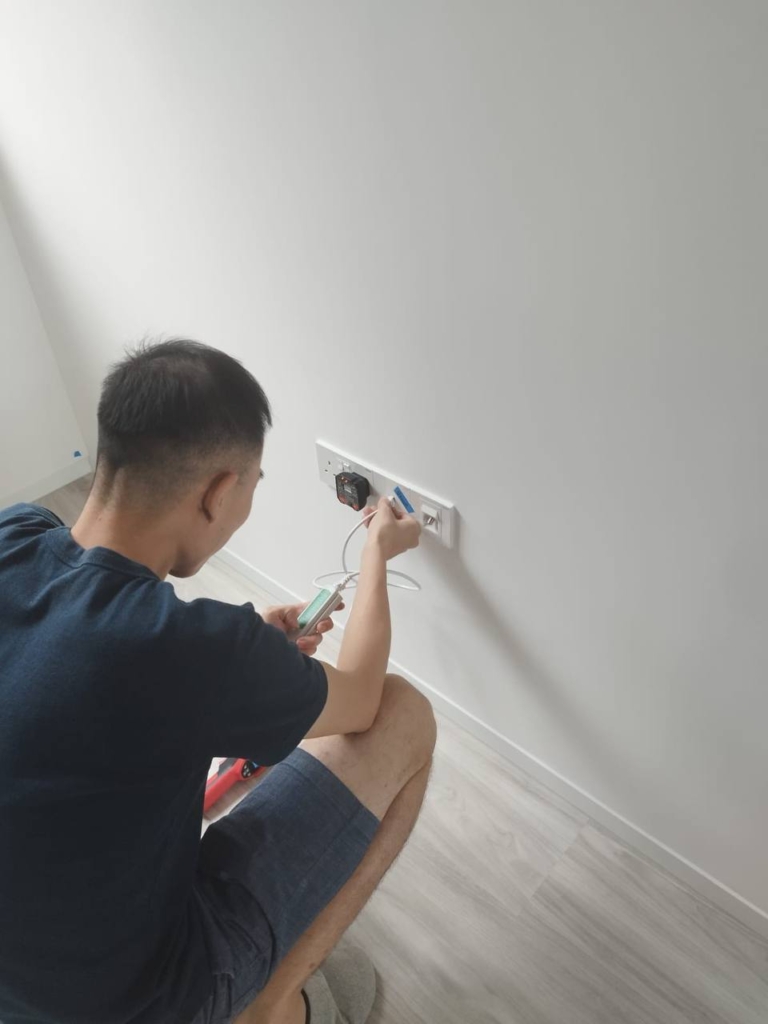
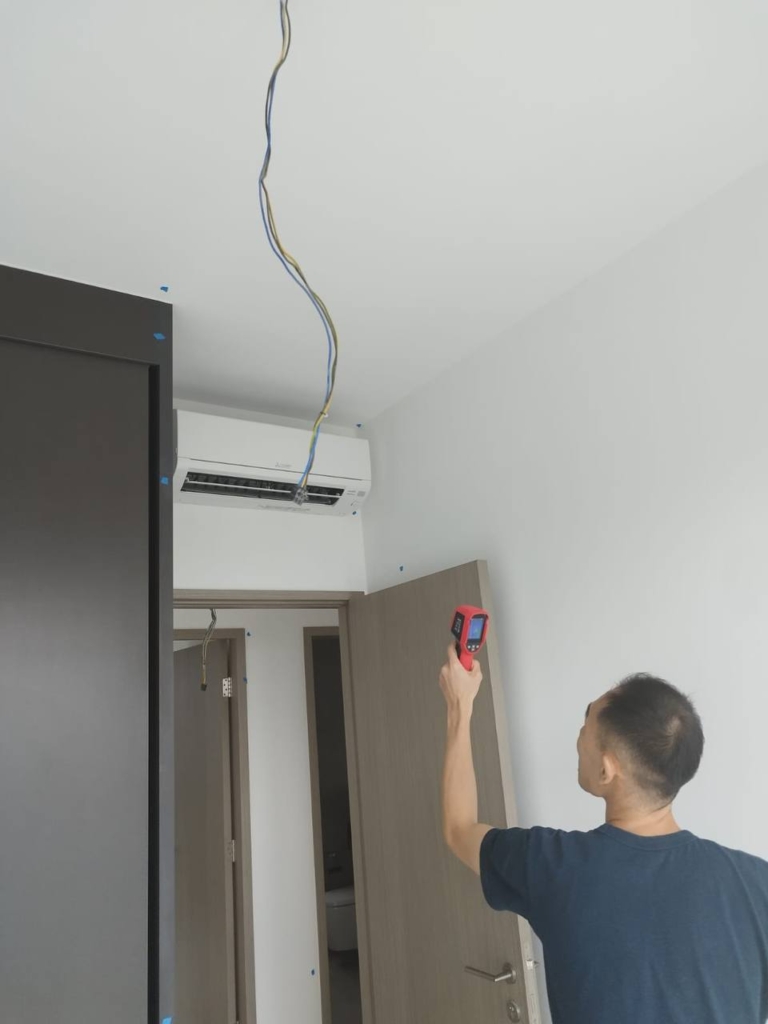
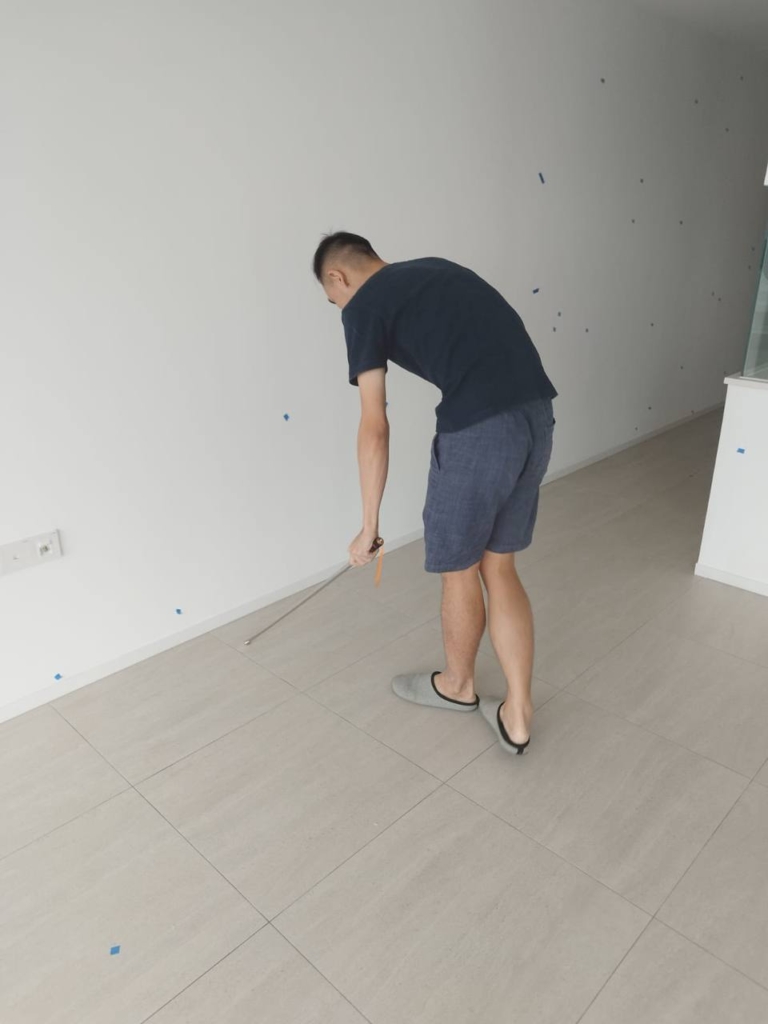
Such home inspection companies can provide you a peace of mind as they do a proper inspection of all parts of your new homes.
They will do a through inspection and provide a detailed report on what areas of your home that will need rectification.
Here are some pages from their defect check report from an actual client:

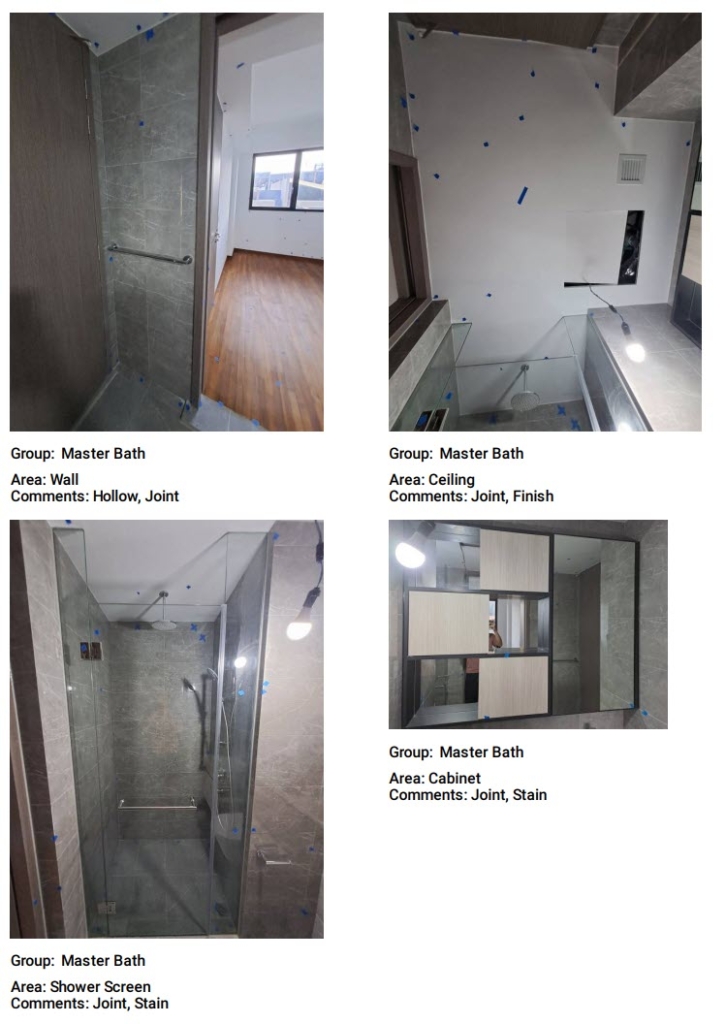

The costs of engaging a professional to do a thorough home inspection is dependent on the size of your property. Bigger homes will cost more.
The fees for this professional home inspection usually ranges to a few hundred dollars.
However, during the TOP period – such companies will offer a group discount so more homeowners feel encouraged to participate.
There will be usually 3 rounds of inspection:
1st inspection is to check your house, identify defects with stickers and document the defects for your submission to developer according to their format.
2nd inspection is a joint inspection to run through the defects with main contractor and developer.
3rd inspection is to check whether rectifications works are carried out to satisfaction and to advise you if there are still outstanding or new defects before closing/handover.
Conclusion
While home inspection is important, do consider that time is of the essence. This is especially so if you bought the unit as an investment to be rented out.
Waiting for the defects to be rectified can take some time and it also means a cost of having a vacant unit and a loss of rental income.
So if the defects are relatively very minor, I recommend quickly moving through the process of finding a tenant.
Similarly, if you are currently renting and wish to quickly move in to save on your rental costs – don’t let this defect check process and rectification delay you too much.
Have further questions on the procedure for key collection?
Unsure on how to do the defect checks of your new home?
Let me know.
Drop me a WhatsApp message at https://wa.me/6596588476
